LH Ovulation Test MIDSTREAM

A rapid test for the qualitative detection of luteinizing hormone (LH) in a urine sample.
For self-testing in vitro diagnostic use only.

The LH Ovulation Self-Test Midstream has been developed to provide a qualitative result for the presence of an LH surge in urine.
This LH surge is an important hormonal indication that ovulation is likely to occur within 24–36 hours.

This test provides preliminary information and is intended as an aid in predicting the fertile period.
People should not make medical decisions based solely on this test and should consult a doctor or healthcare provider if they have questions about fertility.
This test is not a form of contraception.

What is ovulation and why is LH important?

Ovulation is the release of an egg from the ovary.
The egg can be fertilized for approximately 24 hours.

Immediately before ovulation, the body produces an increased amount of luteinizing hormone (LH).
This increase is called the LH surge and usually occurs halfway through the cycle.

The LH Midstream Self-Test detects this peak and thus helps to predict the moment of maximum fertility.

The start day depends on the length of your menstrual cycle.

  • With an average cycle of 28 days, you usually start on day 11 after the first day of your period.
  • If your cycle is shorter than 21 days or longer than 38 days, consult a doctor.


The IFU contains a table with cycle lengths and the correct start day.
(This table can be found on the ovulation test page.)

For reliable results:

  • Test at around the same time every day
  • Do not use first morning urine
  • Reduce fluid intake 2 hours before testing
  • Read the result after 3 minutes (no longer after 10 minutes).

PROCEDURE

Determine the day on which you will begin testing using the "Table for starting testing."

1. Ensure the packaging is at room temperature before opening. Remove the test from the sealed packaging while urinating and use it within one hour.

2. Remove the cap. Hold the test by the thumb grip with the cap and, while urinating, hold the test with the exposed absorbent tip pointing downwards directly in the urine stream for at least 15 seconds until the tip is completely saturated. (See image below)

CAUTION: Do not urinate on the result window. If you wish, you can collect your urine in a clean, dry container and then immerse the absorbent tip of the test in the urine for at least 15 seconds while urinating.

3. After removing the test strip from the urine, immediately replace the cap on the absorbent tip, place the test strip on a flat surface with the result window facing up, and start the timer.

4. When the test begins to work, you may see a light-colored flow moving through the result window. Read the result after 3 minutes. Wait one minute longer if no result is displayed. Do not read the result after 10 minutes.

READING THE RESULTS

POSITIVE: Two colored lines are visible, and the line in the test line area is equal to or darker than the line in the control line area.

This indicates that you will likely ovulate within 24-36 hours .
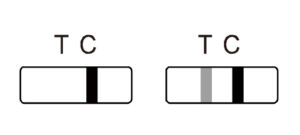
NEGATIVE: Two colored lines are visible, but the line in the test line area is lighter than the line in the control line area, or there is no line in the test line area.

This indicates that no LH surge has been detected and that daily testing should continue.

INVALID:

The result is invalid if no colored line appears in the control line area, even if a line appears in the test line area. You can repeat the procedure with a new test.

Frequently Asked Questions

Do you have a question about one of our self-tests? Below you will find the answers to the most frequently asked questions.
If your question is not listed, please feel free to contact us at info@quanitvadx.eu.

Once you have determined the best day to start testing based on your monthly cycle, you can perform the test at any time during that day. Testing with first morning urine is not recommended, as it is concentrated and may produce a false positive result. Testing between 10:00 a.m. and 8:00 p.m. is a good time frame, but research has shown that testing around 10:00 a.m. is most appropriate. Testing between 10:00 a.m. and 8:00 p.m. is a good time frame, but research has shown that testing around 10:00 a.m. is most appropriate. Test at approximately the same time each day. Reduce your fluid intake for 2 hours prior to testing.

No, the test should not be used as a form of contraception.

A clinical evaluation was conducted, comparing the results of the LH ovulation test with another commercially available rapid LH urine test. The in-house clinical study included 300 urine samples. The results showed >99.9% specificity and >99.9% sensitivity with an overall accuracy of >99.9%.

If no line appears in the control area after 3 minutes, the result is invalid and you must repeat the test with a new test. Contact the manufacturer if the problem persists .

Since not every woman always ovulates halfway through her cycle, it is possible that you will not detect the LH surge in the first seven days of testing. This may mean that you have not yet ovulated and that you should continue testing with an additional LH test.

Approximately 90% of ovulating women with regular cycles will observe the peak during 8-10 days of testing. If this is not the case for you, it may mean that you have not ovulated this month. If you have a short cycle this month, it is possible that you ovulated before you started testing. If you have a long cycle this month, you may not have ovulated yet. If you have a long cycle this month, you may not have ovulated yet. You can continue testing or start again next month. Don't worry; it's normal to have a short or long cycle from time to time, or to have a cycle without ovulating.

First, it is important to remember that normal, healthy couples often need many months to conceive. There are many factors that can affect your ability to conceive, even if you have had intercourse during your fertile days. If you are still not pregnant after several months, consult your doctor or healthcare provider.

If you are already pregnant, have recently been pregnant, or are going through menopause, you may get a misleading result. Some prescription medications, such as menotropins for injection and Danazol, may affect the results you see. Consult your doctor if you have any questions about interaction with prescription medications.

After using the pill, your cycle may be irregular and it may take some time before it stabilizes again. You can wait until you have had two normal menstrual periods before using the Today test.

Sperm can survive for up to 72 hours, and this test only predicts your LH surge 24 to 36 hours in advance. So if you have intercourse before determining your surge, the egg can still be fertilized. If you have intercourse before determining your surge, the egg can still be fertilized.

The LH ovulation test detects luteinizing hormone (LH) in urine in concentrations of 40 mIU/mL or higher. The addition of FSH (1,000 mIU/mL), hCG (10,000 mIU/mL), and TSH (1,000 μIU/mL) to negative (0 mIU/mL LH) and positive (40 mIU/mL LH) samples did not result in cross-reactivity.

No, but you should consult your doctor if you are taking hormonal medication. Recent use of oral contraceptives, breastfeeding, or pregnancy can also affect the test results.

The test should be read after 3 minutes for the best result. A positive result (peak) will never disappear. The colored line(s) may become darker and a tinted background may appear after a few hours. In some negative results, a faint second colored line may appear later due to evaporation of the test line. Therefore, do not read the results after 10 minutes. Discard the test after reading the result.

The LH ovulation test does not replace the BBT method. The change in basal body temperature mainly indicates that ovulation has already occurred. The LH ovulation test indicates that ovulation is about to occur.

There are many factors that can affect your ability to conceive. It can take a number of months for normal, healthy couples to conceive, and often you will need to use the test kit for 3-4 months before you conceive. If you have not conceived after 3-4 months, you and your partner should consult your doctor.

The HCG pregnancy test can show results from the first day of your missed period. The HCG pregnancy test can show results from the first day of your missed period.